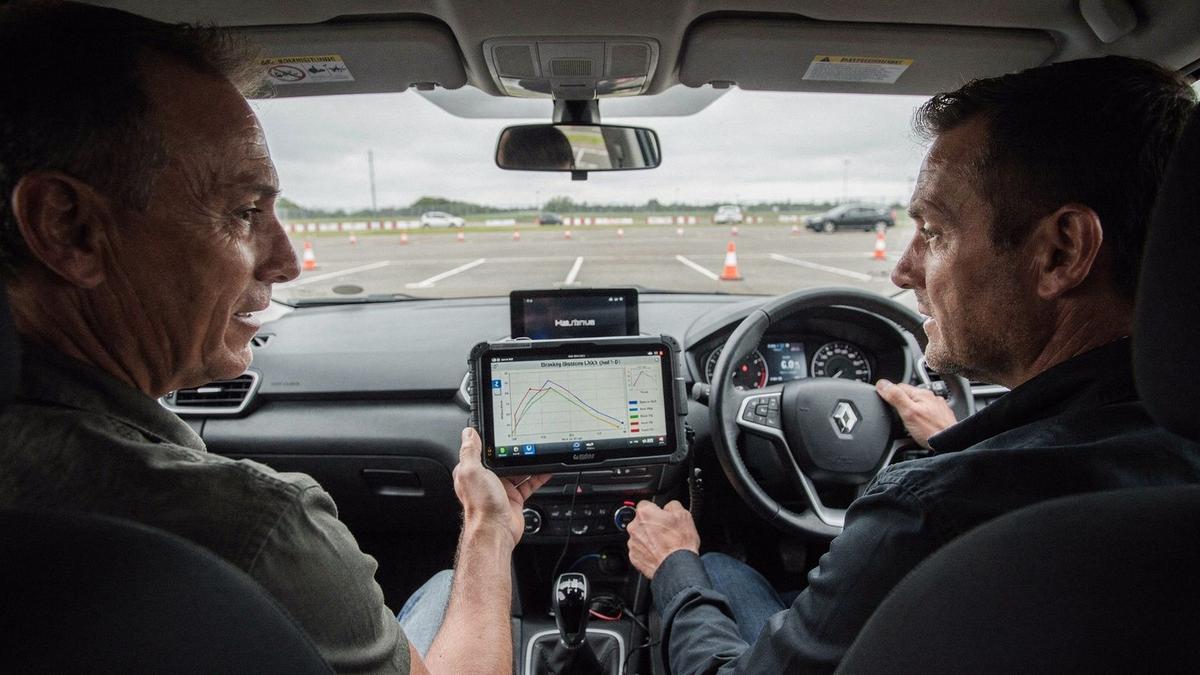
Advanced driver training / closed private courses
Six participants per instructor. Instructor-set speeds. No public roads, and a session stops the moment a mandatory vehicle check fails.
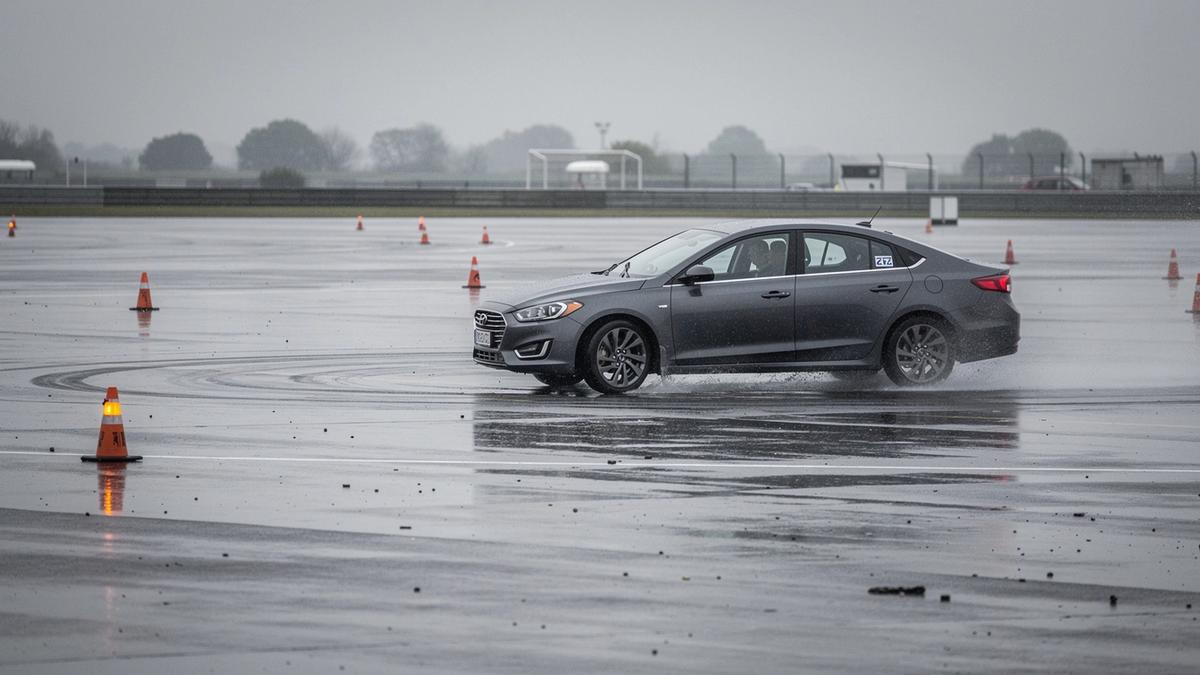
Shorter wet-pad braking distance
-18m
Median across 24 drivers, measured from 80 km/h on a watered skid pad. Dry reference lap logged before every run.
Baseline
Four situations most drivers meet in an ordinary week. Before the first drill we log how you handle each one, so the programme starts from your driving rather than from a syllabus.
| Scenario | What the first session measures |
|---|---|
| Wet roundabout entry after dark | How early the throttle comes off, and whether the mirrors are checked before the wheel moves. |
| Emergency stop on a downhill approach | Stopping distance in metres, on a closed course, on your own tyres. |
| Overtaking on a two-lane road | The gap you actually accept, set against the gap you believed you accept. |
| The fourth hour of a motorway leg | The first sign of attention drop, logged in minutes rather than recalled afterwards. |
Method: every row is recorded on closed private courses at instructor-set speeds. No public road is ever used.
See how the programme answers each row Book a baseline session
Drill index
Pedal pressure is built in stages to the ABS threshold, then held as the surface changes beneath the tyres. Each run starts at 80 km/h over a standing-water sheet held at 2 mm.
Cones set 3.5 m apart define one lateral move, with no braking allowed on the first attempt. Instructors log exit speed and the steering angle at the second apex, then compare both runs.
Rear slip is induced on a wetted circle at instructor-set speeds. You practise opposite lock and a measured throttle release before yaw rate passes 25 degrees per second.
The cue is steering weight, not sound: the wheel goes light and the correct response is no braking and no steering input. Runs continue until you call the loss within half a second of onset.
Lamp aim, mirror position and dip timing are checked before every run on an unlit section. You repeat the same 1.2 km loop until your speed matches the visible stopping distance.
Each exercise closes with a debrief, then one repeat run with a single variable changed. Nothing is scored on feel; the numbers from both runs are printed and read side by side.
Evidence band
| Scenario | Before training | After training | Delta |
|---|---|---|---|
| Emergency braking from 90 km/h | 41.6 m | 33.1 m | -8.5 m |
| Avoidance swerve at 70 km/h | 61% clear | 94% clear | +33 pts |
| Trail braking into a wet corner | 2.8 s | 2.1 s | -0.7 s |
| Skid recovery back to line | 4.9 s | 2.4 s | -2.5 s |
| Mirror and blind-spot scans per minute | 1.4 | 3.2 | +1.8 |
Method In-car telemetry logged at 20 Hz; avoidance runs scored by the same instructor on both passes.
Sample n = 148 participants, six participants per instructor, 2022, 2023 and 2024 cohorts.
Surface and year Dry closed-course asphalt, 2024 cohort. Wet-corner rows measured on the handling pad, 2023.
Instructors and supervision
Every session is led by an instructor holding a certificate of advanced driver training issued by a national road safety authority, last verified in 2024. Coaching runs on closed, private courses only. No public roads, no traffic, no laps timed against the clock.
Instruction is given at instructor-set speeds. A vehicle check is completed before the first run and repeated after every driver change. If surface or light conditions shift, the session stops and the group moves to the debrief room.
Supervision ratio fixed by the school operating standard, revision 2024.02
If a drill cannot be run safely on the day, it leaves the plan and that time goes to the debrief. Book an enquiry call to walk through the ratios and course rules.
Booking
Six participants per instructor, instructor-set speeds, private course only. Send the form and we reply with dates, vehicle requirements and the fee schedule.
Direct lines: contact@simimpactin.com · +380 674 624 3013 · 7B Antonovycha Street, Office 305, Kyiv, 03150. Full breakdown on the programme page.